Sensitive webs: two days of sensitive machines
At a two-day Sensitive Machines hackathon with the Institute for Future Technologies, we built two webs you play with your hands: one that answers with sound and spoken prompts, and one that answers with ripples of light.
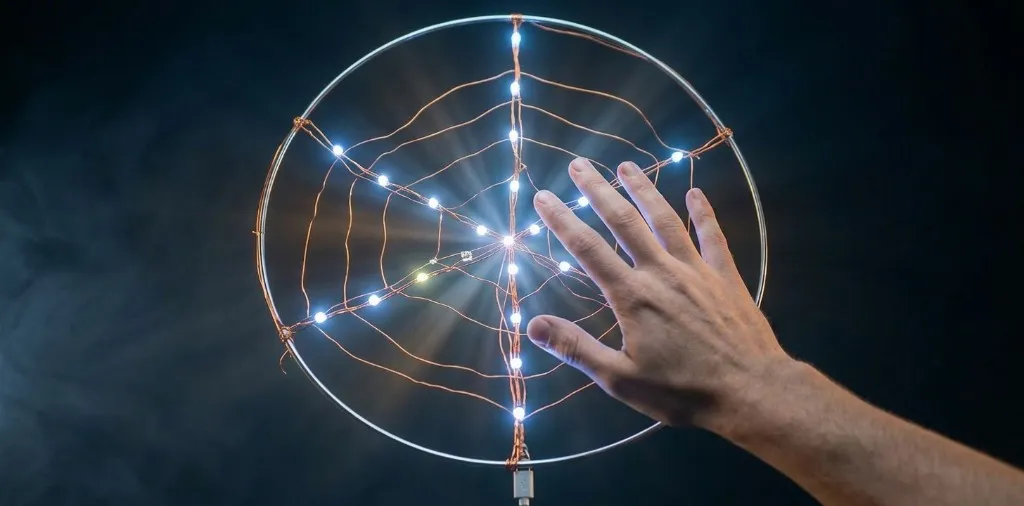
In June, Sony CSL Paris welcomed the Institute for Future Technologies for a two-day workshop on Sensitive Machines. Researchers, artists, designers and students formed small multidisciplinary teams to prototype interactive, responsive systems across software, hardware and materials. Thanks to David Colliaux and Aliénor Lahlou for organising it.
Zéphir and I were in a team with Mariana Tamashiro, Paul-Peter Arslan and Thomas Juldo. Our starting point was a web: something you reach towards rather than press, that notices you before you touch it. Over the two days it became two prototypes.
Sensitive Webs
The first is a dream-catcher-style web of enamelled copper wire, wired into a XIAO ESP32-S3 that senses capacitance on each wire. It turns your gestures into a sonic atmosphere and invites you to notice how you feel.
Each wire is a ring of the web, with two layers of response:
- Bringing your hand near a wire slowly raises an ambient tone for that ring.
- Touching it plays a short spoken cue.
Each ring has its own tone and its own theme of cues: greetings and goodbyes, invitations to stay with your current posture and feeling, in- and out-breath guidance to help you attend to bodily sensation, and prompts to recall last night’s dreams.
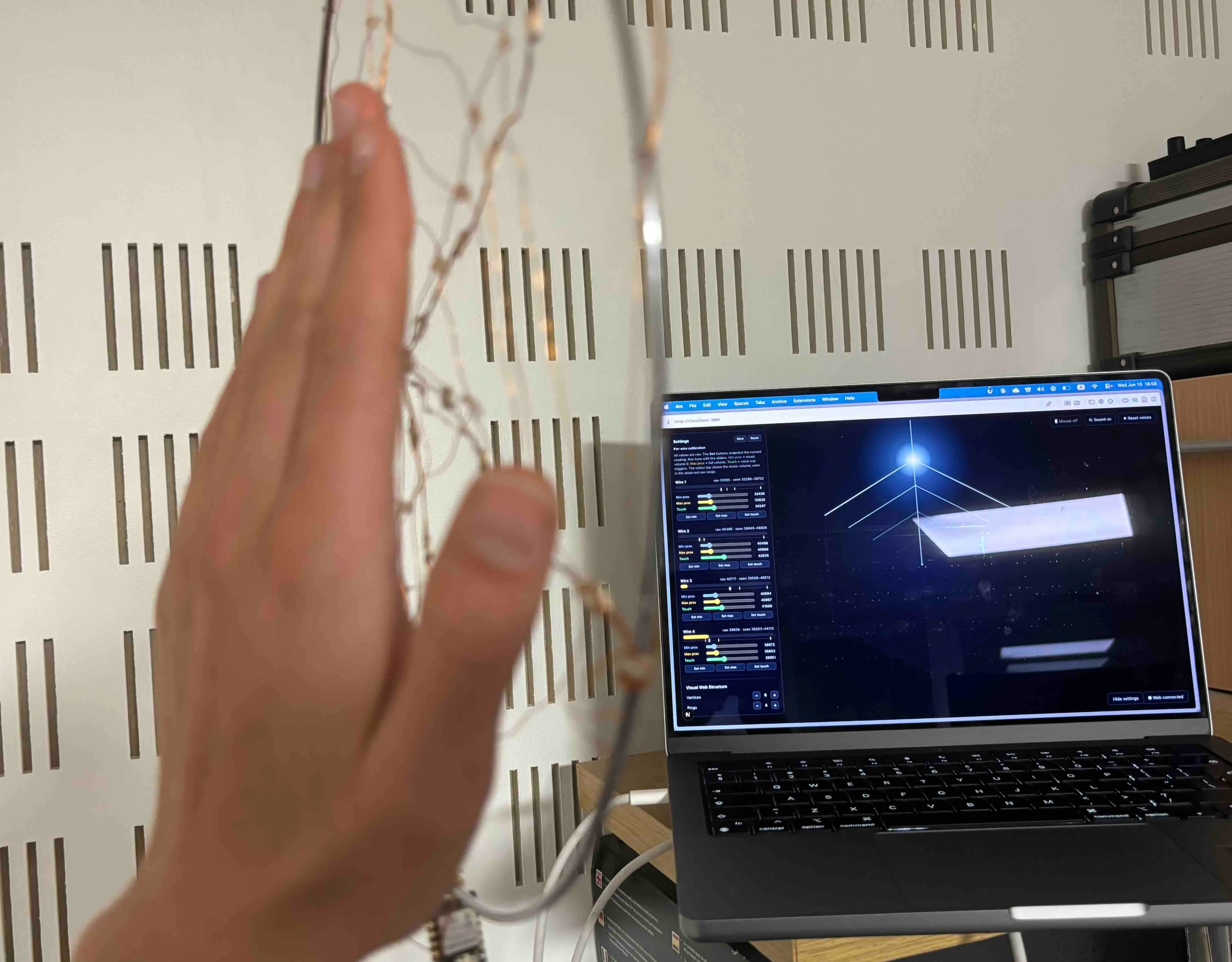
The on-screen web mirrors the physical one. A settings panel calibrates each wire live: where proximity sensing starts, where the music reaches full volume, and where a touch fires a cue. That matters because every wire, hand and room reads differently.
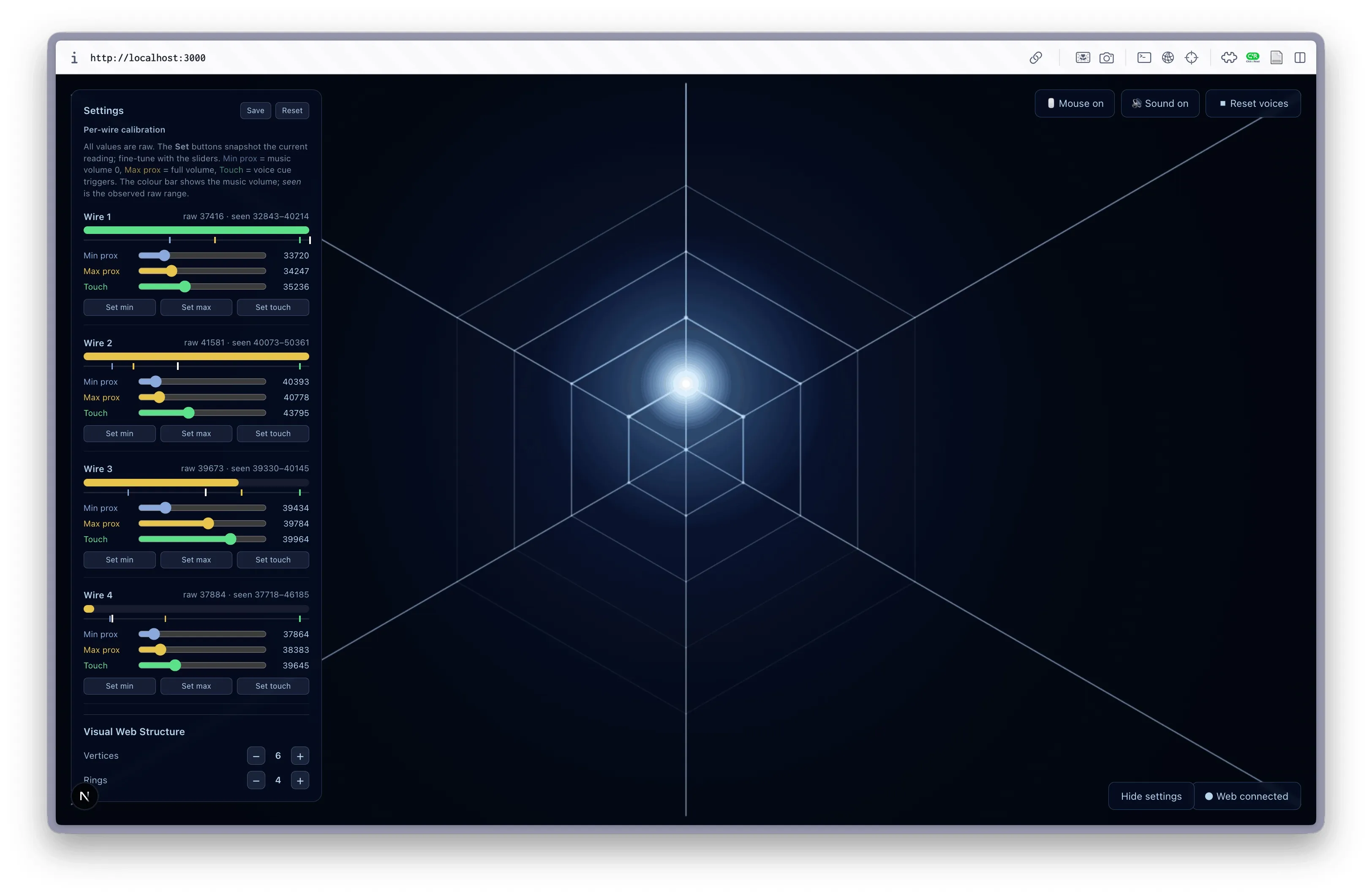
Zéphir’s repository has the interface, the firmware and the voice cues: zephirl/sensitive-webs.
A web you play with light
The second prototype is a spider-web you play like an instrument, built for a physical web of LEDs with capacitive touch.
- Touch a strand and a ripple of light runs across the web while a chime rings out.
- Press harder and the ripple grows into a wave that spreads through the whole structure.
- Beads along the strands bend the light: some speed it up, some funnel it one way, and some bounce it back.
Underneath, an ambient glow shimmers, breathes or twinkles across the web, and a drone chord follows what you do: the more you play, the richer it gets.
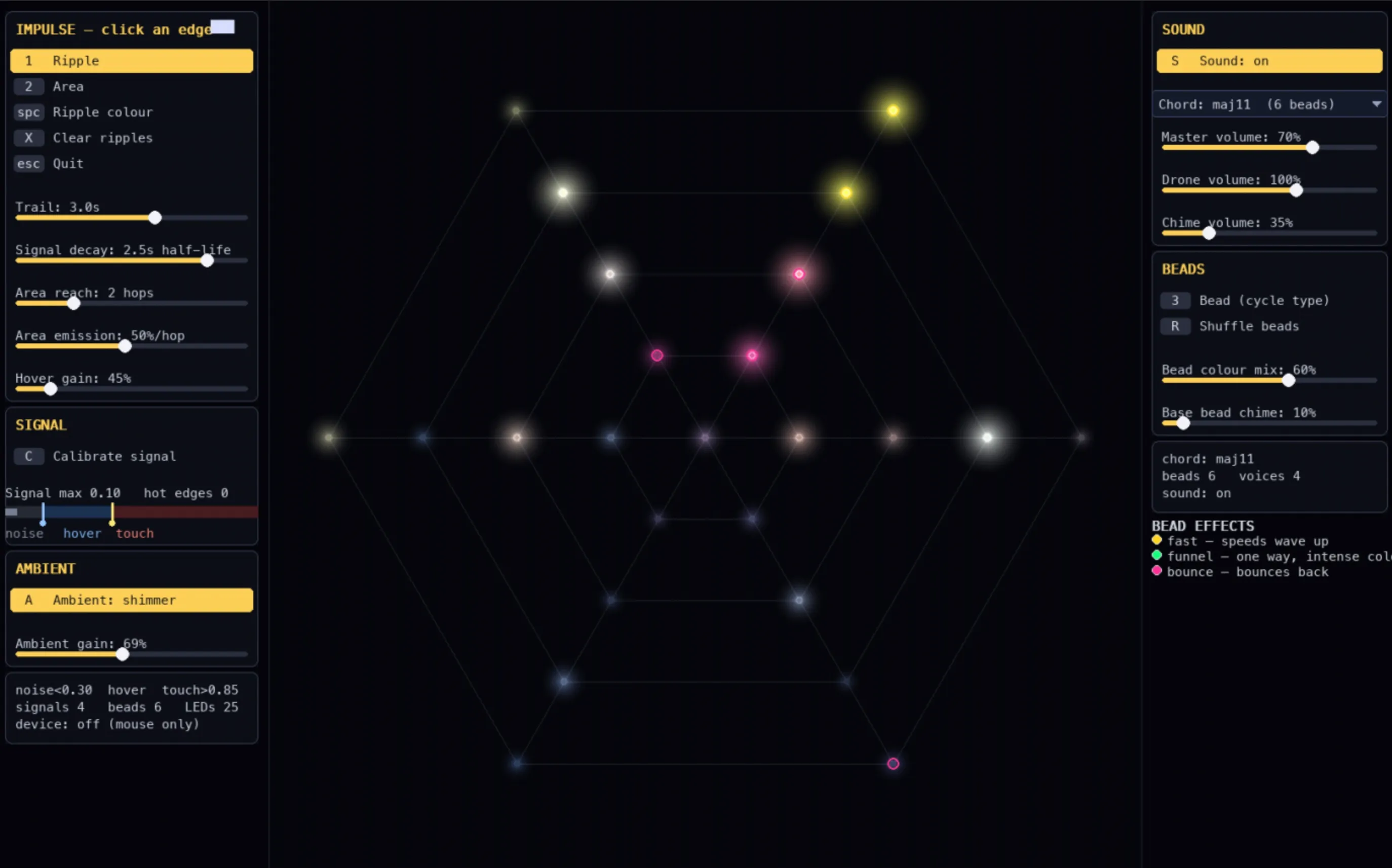
You can play it in your browser without any hardware. The repository also has a desktop version and an installation mode that drives real LEDs through an ESP32: MBAnslow/ift-x-csl-web-lights-sounds.
What we took from it
The two prototypes are halves of one idea. Sensitive Webs listens closely and answers with sound and voice; the light web answers with light moving through a structure. The next step is to bring them together, so the physical web lights up as you approach it and its sound changes with the light. A second workshop is planned for autumn 2026 to do that.
For Cloudfulness, it was a chance to test ideas we care about in a lighter form: a material that responds before you touch it, guidance that invites rather than instructs, and light and sound that feel like one gesture.