A call for belonging
Open to collaborate
We really enjoyed working and thinking about belonging and bringing that together to form our cloud. We're more than happy to expand on this work so please reach out!
Start a conversation
What it could lead to
Possible outputs
To show what working together might produce, here are some possibilities: a belonging checklist for crafting installations, a workshop on belonging, an exhibition on different types of belonging, exploration of small practices to belong in everyday contexts, and a website to share experiences of belonging. All are tentative, and we would like to shape them with collaborators.
Example output · Designing a belonging checklist · draft
Designing a space where people can belong
A checklist for belonging installation at the intersection of art and cognitive science. It isn’t a recipe, and you don’t need to cover every point. It is an example of what could be relevant: use it to see which parts of the design and experience space you are working in. It also serves to help explore this space as a community.
Compiled (with AI assistance) from our literature notes on belonging, group mindfulness and ritual media (Malaver Turbay, 2022), then edited by us.
Purpose & framing
- Name the dimension of belonging you are after
- Build a symbolic world that is both personal and universal
- Make it non-competitive and non-evaluative
- Signal at the door that everyone here belongs
Ritual structure
- Design a clear sequence
- Give it a rhythm people can settle into
- Create a liminal space
- Let it deepen over time
- End together
Social & relational dynamics
- Invite one small, reciprocal disclosure
- Make room for real listening
- Share after the practice
- Create conditions for co-regulation
- Leave a path to meet again
Cognitive & emotional layer
- Reframe: what you feel is shared
- Offer a warm moment early
- Keep autonomy and choice
- Leave silence and empty space
Embodied & sensory design
- Engage several senses at once
- Use warmth, literal and metaphorical
- Design the floor and the posture
- Let sound carry presence
- Offer an object to touch or carry away
Immersion & interactivity
- Close the loop with biofeedback, gently
- Balance guidance and openness
- Make belonging visible in gesture
- Treat onboarding as part of the work
Environment & space
- Choose a space that feels intentional
- Treat light, air, temperature and noise as belonging cues
- Look for existing place-attachment
- Let spatial flow mirror an inner journey
Listening afterwards
- Begin with a short inward question
- Collect stories without steering them
- Ask whether connection was felt or performed
Example output · a possible workshop
A workshop on making spaces for belonging
We would be open to (co)organising a workshop for artists, designers, researchers, students and communities. Whether to formally explore the concept through an academic lens towards academic papers, or to engaging with it in a creative workshop to explore new belonging creations or just to engage with the topic more to bring belonging into our everyday lives.
Host it with us
Would you like to explore a workshop like this at your school, lab, festival or community space? We would be glad to shape one together.
Start a conversationPossible output · an exhibition
An exhibition on belonging
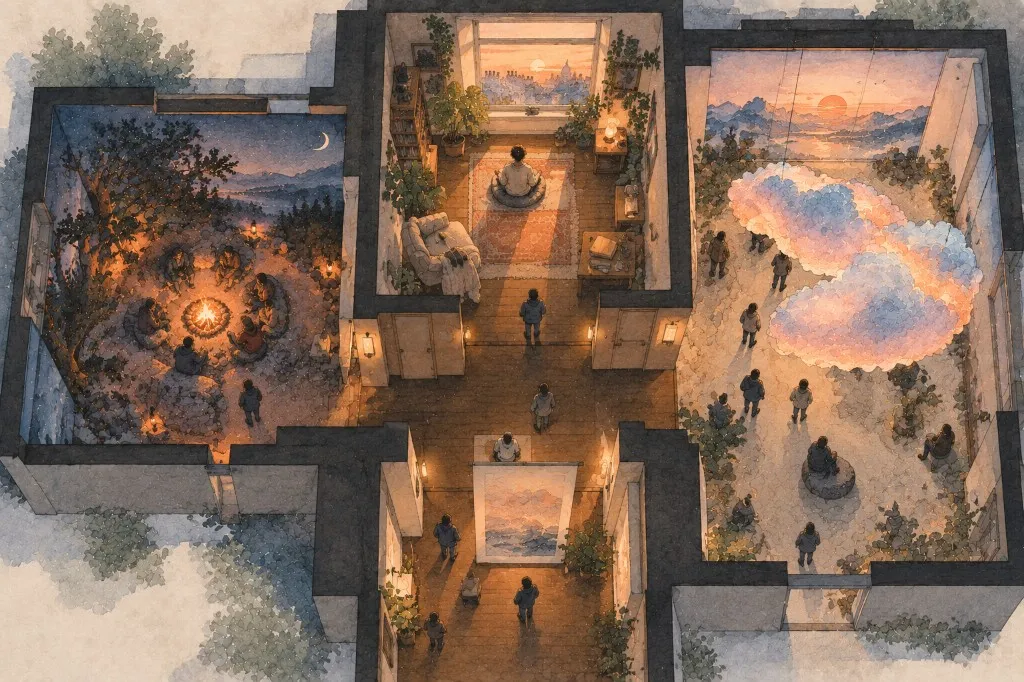
We would like to bring together installations on different kinds of belonging in one exhibition, and we invite artists, designers and researchers to propose their own. Cloudfulness looked at belonging to nature through the sky above us; alongside it, other works could explore belonging in other directions.

To people
Belonging to each other: strangers, friends, families and communities, and what makes us feel seen and accepted.

To ourselves
Belonging in our own bodies, memories and stories: feeling at home in who we are.

To nature
Belonging to the sky, the weather, the living world and the places we share with it.
Possible output · everyday practices
Designing belonging for everyday contexts
Four small practices that could carry belonging beyond an installation, into daily life.
- The next time you see a cloud, take three breaths with it. Where was this water yesterday?
- Notice a moment today when someone made you feel you belonged. What exactly did they do?
- Think of a place where you belong. Which sense brings it back first — a sound, a smell, a texture?
- Offer someone five minutes of listening without replying.
Possible output · community sharing platform
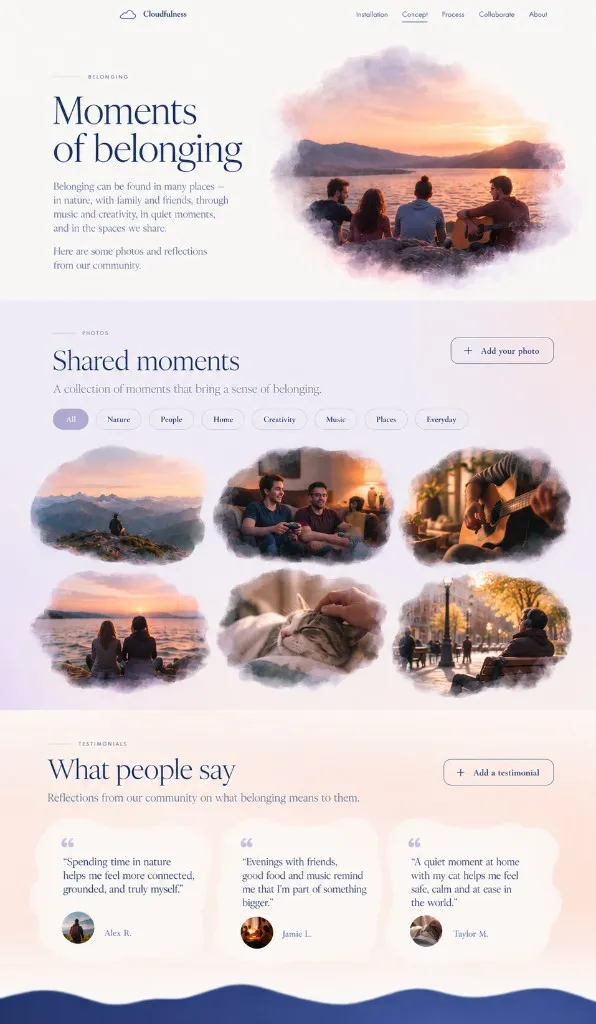
A website for sharing moments of connection
By focusing on community sharing, we imagine extending the physical installation into a shared digital space where anyone can contribute their own moments of belonging.
Through photos, stories, and personal reflections, participants can share what belonging means to them. This digital space functions as a living, growing collective archive of human belonging and the forms of connection behind that, taking the themes of the installation beyond a single room and inviting a wider public to participate.
We found an existing example of a website sharing an individual's photographs of clouds and mindfulness we thought we would share (not affiliated with us):